
Hampshire County Release Meanings
A Hampshire County release record must answer more than whether a jail stay ended. The Hampshire Sheriff may record a return to the community, a move into supervised status, or a handoff to another custodian. That last group includes the Massachusetts Department of Correction, another county, a warrant-holding agency, federal authority, or immigration authority. Some administrative events even end one legal status while the person remains in the same building. For that reason, the actual release time, legal authority, release type, and destination belong together.
The Jail and House of Correction combines two roles. Its jail function holds people before trial, while its house-of-correction function serves county sentences of no more than two and one-half years. A pretrial stay can end through bail, personal recognizance, or a court order. A sentenced stay may end through time served, expiration, parole, probation, or another lawful result. Once a person leaves Hampshire custody, a court, state agency, or receiving custodian may hold the next useful record.
Note: A person who leaves county custody will not necessarily have a continuing public corrections profile.
Hampshire County Release Types
Massachusetts separates community outcomes from custody transfers and legal-status changes. The state’s official admissions and releases definitions are the sound way to read a Hampshire event. A release without supervision can reflect sentence expiration, discharge, or another final outcome. Release with supervision generally points to probation, while parole to the community places the person under the Massachusetts Parole Board. Bail and recognizance end a jail stay while the criminal case remains open.
| Release type | What it means | Where to verify next |
|---|---|---|
| Bail or recognizance | Pretrial custody ends, but the case continues. | Sheriff record and originating court docket |
| Time served or sentence expiration | The imposed county term has been satisfied. | Sheriff release record and sentencing court |
| Parole to community | Institutional custody ends while the sentence continues under parole. | Release record and Massachusetts Parole Board |
| Probation supervision | The person is subject to court-ordered community supervision. | Sentencing court and Massachusetts Probation Service |
| Home confinement | The physical setting changes, but a court-controlled custody status may remain. | Court order and responsible supervising office |
| Transfer or agency handoff | Hampshire custody ends because another justice agency accepts the person. | Destination field and receiving agency |
| Remain incarcerated | One sentence or status ends while another begins without a community exit. | Full sheriff record and related commitments |
The release type alone may still be incomplete. “Released to another criminal justice agency” can cover a state sentence, federal authority, immigration authority, an out-of-state sentence, a warrant, or a consecutive house-of-correction term. Ask where the person went. That one field distinguishes a community return from continued confinement.
The official Hampshire Sheriff site identifies the local custody system and its programs. The agency’s published pages are shown below, but they do not provide a name-based roster or release search.
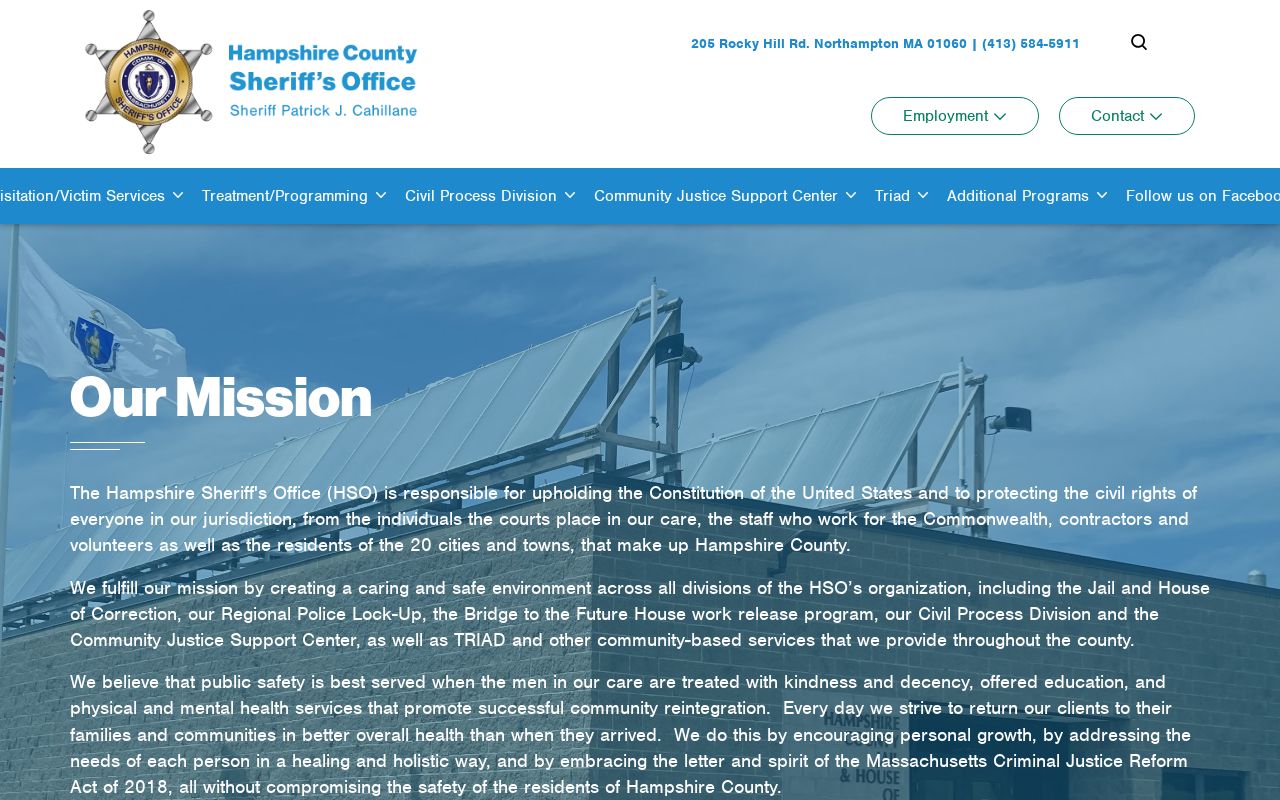
The screenshot helps identify the responsible office, not a person’s status. A named release still requires phone, record, and court confirmation.
Hampshire County Release Record Fields
The Hampshire Sheriff’s Offender Management System includes a booking number, booking date, and release date. Massachusetts regulation also requires a prisoner calendar with the time and authority for each release. G.L. c. 126, § 40 requires the sheriff to record further data, including release type, sentence length, jail credit, earned time, disposition, and bail information. A focused request should seek the smallest useful set of fields, since parts of an internal file may be withheld or redacted.
| Field | What it shows |
|---|---|
| Full name and booking number | Ties the result to the correct Hampshire admission. |
| Booking date and time | Marks the start of the recorded custody episode. |
| Actual release date and time | Shows when Hampshire custody or the recorded legal status ended. |
| Release type | Identifies bail, recognizance, time served, parole, probation, expiration, transfer, or another outcome. |
| Legal authority | Connects the exit to a court order, sentence event, parole action, or other authority. |
| Destination or receiving agency | Separates a community release from continued custody elsewhere. |
| Case or commitment number | Lets the requester reconcile sheriff, court, and state records. |
A quarterly Chapter 126 report is not a substitute for this person-level record. The report is non-identifying and useful only for aggregate trends. Nor does a booking photograph prove release. It shows that an image was taken during booking, while the calendar and release fields establish what happened at the end of custody.
Note: Request segregable public portions so the office can redact protected material without withholding the whole responsive record.
Request Hampshire County Release Records
A written request creates the clearest record of what was sought and preserves public-record appeal rights. The Hampshire Sheriff has no special release-record portal or fixed booking-photo fee. Direct a narrow request to Thomas Mitchell, Public Information/Records Access Officer. Ask for electronic delivery, a fee estimate, and redaction of exempt details rather than a denial of the full record.
- Gather the full legal name, approximate booking range, booking number if known, arresting agency, and court docket number. Include a birth date only when needed to distinguish the person.
- Call the sheriff at (413) 584-5911 and ask whether county custody ended, the actual release date, release type, and destination.
- Send the written request to the Hampshire records officer at Thomas.Mitchell@hsd.state.ma.us or 205 Rocky Hill Road, Northampton, MA 01060. Mail may also go to P.O. Box 7000, Northampton, MA 01061-7000.
- Request the booking or admission record, actual release time, release authority, type, and receiving agency. Ask for the booking photograph as a separate item only if needed.
- Review any cited exemption and compare the response with the court docket or receiving agency’s record.
Under G.L. c. 66, § 10, an agency ordinarily produces a reasonably described public record without unreasonable delay or sends a written response within ten business days. That response may identify withheld portions, exemptions, a fee estimate, and a production schedule. State-agency labor rules generally provide the first four hours without charge and cap ordinary labor at $25 per hour unless added authority applies. Black-and-white copies are capped at $0.05 per page, while an electronic record may avoid copy charges.
No online retention period exists because Hampshire has no online roster. That fact says nothing about the internal record schedule. Sealing, impoundment, juvenile confidentiality, and expungement can restrict later access. Expungement is broader than sealing and can require justice agencies to remove qualifying records and answer that none exists. A missing public result may therefore reflect law, not a failed search.
Hampshire County Release Record Law
Massachusetts public-record law begins with a presumption of access, but it also recognizes specific exemptions. CORI restrictions, personal privacy, open investigations, juvenile confidentiality, and facility safety may affect a Hampshire release response. An office does not have to create a new report or answer open-ended questions. It must address an existing, reasonably described record and provide a segregable public portion when feasible.
Courts operate under a different access system. A Hampshire Sheriff or MA DOC request follows executive public-record rules. A docket or court document is obtained from the clerk under Trial Court public-access rules. The online MassCourts display is a discovery tool, not the official file. An attested court copy has its own court fee schedule, and a correction to an online docket uses the Trial Court correction process rather than a demand to the sheriff.
- Discharge
- The sentence or custodial term ends without a remaining corrections hold in that system.
- Time served
- The court credits time already spent in custody as the imposed term.
- Detainer
- A notice or hold showing another authority may claim custody.
- Expungement
- A statutory process that can remove qualifying records more fully than sealing.
Note: The court record explains the legal basis, while the custodian’s record shows the physical release or handoff.
WCC Holds Delay Hampshire Release
A Hampshire County case does not always mean the Hampshire Sheriff controls the physical exit. Women committed from Hampshire may be held at the Western Massachusetts Regional Women’s Correctional Center in Chicopee, operated by the Hampden County Sheriff. Its official bail and release instructions show why an order or payment is not the same as walking out.
WCC staff checks for other mittimuses, warrants, detainers, and legal holds after bail is paid. A mittimus is the court document directing custody. One mittimus may be cleared while another remains effective. A court-ordered electronic-monitoring condition can also keep the person at WCC until Probation completes setup and transport. For a Hampshire woman held there, ask WCC for the actual release or transfer record and use the Hampshire court for the legal order.
Property and account procedures are separate from the release decision. WCC publishes pickup details, but those instructions can change. The release record should still state the time, authority, and destination.
Getting Home After Hampshire Release
The main Jail and House of Correction sits at 205 Rocky Hill Road in Northampton. The PVTA Route R44 schedule marks “Hampshire Co. House of Corrections” as a stop on the Rocky Hill route. That is a concrete public transit option after a community release, but it is not a promise that a bus will meet the person or that the sheriff will coordinate the departure with a scheduled trip.
First confirm that the destination is the community. A record naming DOC, another county, federal authority, immigration authority, or a warrant-holding agency describes a handoff instead. If the person is leaving the Rocky Hill campus, compare the actual exit time with the current transit schedule and make a separate plan when service does not align.
Note: A transit stop near the jail does not establish release time, destination, or transportation arranged by the sheriff.
Hampshire Lock-Up Releases Move Fast
The Hampshire County Sheriff’s Regional Police Lock-Up is a short-stay arrest facility on the Rocky Hill campus. Its official audit reported an average stay of four hours and an evening-to-morning operating window. A person can move quickly from arrest to bail, recognizance, court, continued Hampshire custody, or another transfer.
That pace makes a live-roster model a poor fit even if Hampshire published one. It does not. The most useful path is to contact the arresting police agency, the Hampshire Sheriff, and the court expected to handle arraignment. Ask each office a distinct question: who made the arrest, when did sheriff custody end, and what court order or case event controlled the next step?
Does absence from the sheriff website prove release? No. Hampshire publishes no public person list, so there is no roster entry whose disappearance can prove a community exit.
Hampshire Release Events in Context
Hampshire’s Chapter 126 report for July through September 2025 records 102 admission events and 96 release events. These are events, not a count of unique people. The same person may have more than one status event, and a release event may describe transfer or continued confinement under another legal status.
The 1,540 Regional Police Lock-Up detainees reported for its prior audited year belong to a separate short-stay population. Do not blend that figure with house-of-correction releases. The Cross-Tracking dashboard can filter anonymous admission and release events to Hampshire, but it does not identify who was released.
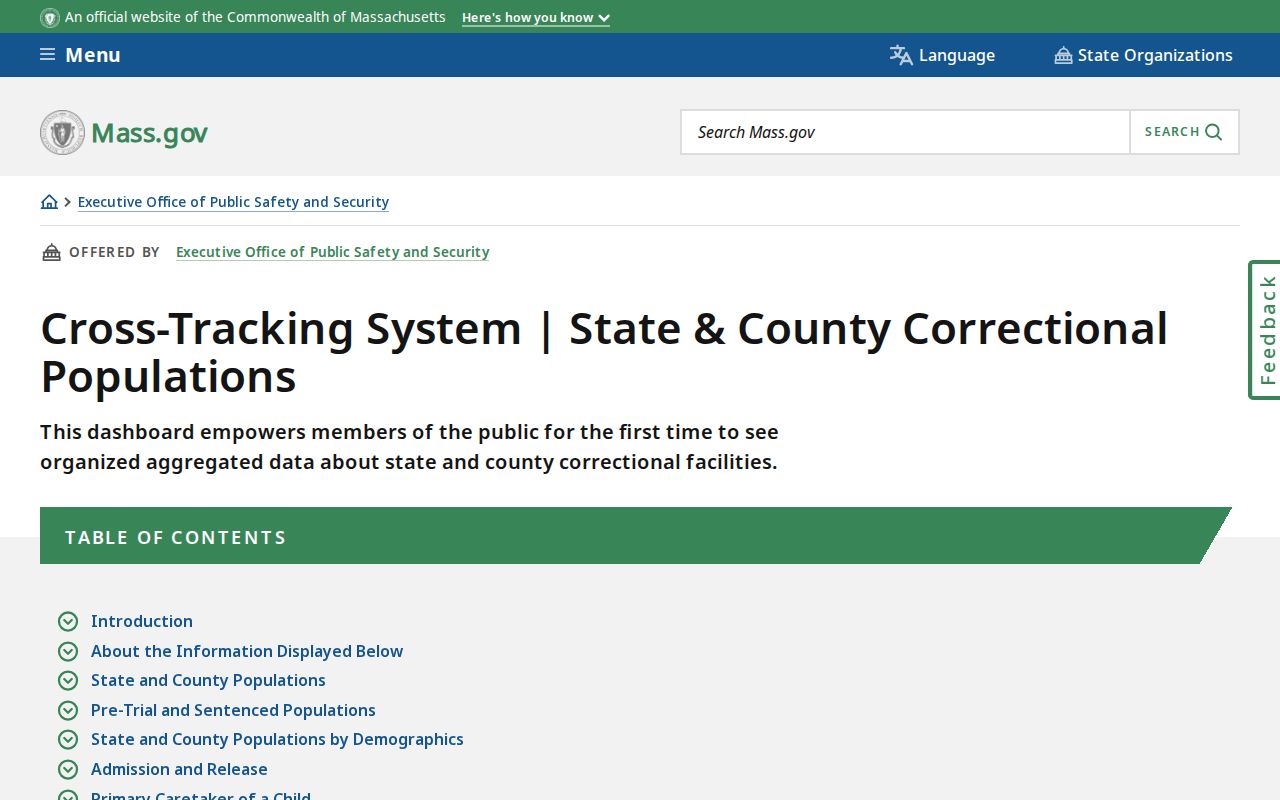
The dashboard is valuable for trends and release-type counts. A person-level answer still comes from the sheriff calendar, court file, or receiving agency.
Search Hampshire County Released Inmates
Start with the last known custody system. Hampshire County, MA DOC, BOP, ICE, and the Trial Court serve different roles. A broad name search across the wrong service can create a false negative. Use exact names, booking or commitment numbers, and the case location when available. Record which system was checked and when.
- For the Hampshire jail or Regional Police Lock-Up, call the sheriff and request the county release record. Ask whether another agency accepted custody.
- Use the court docket and clerk to find bail, recognizance, disposition, sentence, jail credit, probation, warrant, or later order information.
- If Hampshire reports a state-prison transfer, search MA DOC through the Massachusetts VINELink route and seek a DOC discharge record if the live result is absent.
- For a federal sentence, search the BOP locator. For an immigration handoff, test current ICE custody and follow up with the ICE information line.
- For an older Hampshire event, use a narrow records request because there is no sheriff archive search or public recent-release feed.
A negative result must be read in context. A blank Hampshire website search has little meaning because no person roster exists. A missing VINELink result can mean county-only custody, a spelling issue, unavailable older data, or no MA DOC record. A missing ICE result does not prove release. A BOP miss may reflect the wrong query, no federal commitment, or a record before the locator’s 1982 coverage.
Note: Confirm the actual exit and destination before treating a court order, parole vote, bail payment, or missing search result as release.
Massachusetts DOC Release Search
Massachusetts does not maintain a separate permanent MA DOC discharge search on Mass.gov. The official state prison locator instructions send users to VINELink and make one crucial limit clear: only MA DOC participates in Massachusetts VINE. A person held only by the Hampshire Sheriff is outside that stated coverage.
| Search field or term | How to use it | Limit |
|---|---|---|
| Full first and last name | Search the exact MA DOC name and compare identifiers. | Common names and spelling differences can mislead. |
| DOC commitment number | Use the state identifier when known. | It does not identify a county-only booking. |
| Displayed custody or status | Copy the live label exactly. | Released-result retention is not promised. |
| Release Date | MA DOC defines it as a sentence date calculated without earned deductions. | It is a basis for calculation, not always the actual exit. |
| Earliest Release Date | Shows earliest eligibility after possible parole and earned deductions. | It is an estimate or eligibility date. |
| Earliest Release Max Date | Uses the controlling maximum and eligible credits. | It excludes parole eligibility from that calculation. |
For a released state prisoner, save the exact fields shown and then seek the durable DOC record when necessary. Ask for the certificate or order of discharge, actual release date, release institution, legal release type, and destination category. A Hampshire county record may show only that DOC accepted the person, while the later DOC record establishes the state-prison release.
Hampshire County Recent Release Records
The Hampshire Sheriff publishes no official roster, inmate lookup, mugshot page, or named release feed for the last 24 or 72 hours. There is no public refresh schedule or online retention period. The anonymous state dashboard cannot be turned into a list of names. A commercial booking page is also not proof of release because a recent booking can end in continued custody, bail, court release, or transfer.
For a recent Hampshire County release, call (413) 584-5911 and ask for the actual time, authority, type, and destination. If the answer is incomplete, send the same fields in a written request to the records officer. The court docket can confirm the order behind bail, recognizance, time served, probation, or another legal result, but the sheriff record remains the best local proof of the physical handoff.
G.L. c. 127, § 150 adds a local timing point: when a term expires on Saturday, Sunday, or a legal holiday, discharge occurs on the preceding day. A Friday release can therefore correspond to a weekend or holiday sentence expiration. The focused Hampshire release records for the last 24 hours path applies this same evidence chain to a same-day window.
Note: Ask for a stated date range when seeking recent records, since Hampshire provides no public rolling release window.
Hampshire Release Supervision Stages
Three Hampshire programs illustrate why location alone does not prove release. Bridge to the Future is a 16-bed halfway house for men nearing the end of a Hampshire sentence. Its ideal candidate still has at least 120 days left. It is lower-custody pre-release placement, not final discharge.
The Rocky Hill Re-Entry Collaborative is different. It is a post-release Hampshire Sheriff and Massachusetts Parole collaboration for parolees, including an initial 48-hour acclimation period. The Community Justice Support Center at 492 Pleasant Street serves people under community supervision. A person at one of these sites may be in pre-release custody, on parole after release, or participating under another community status.
Parole and probation also differ. Parole is administered by the Massachusetts Parole Board and continues a sentence in the community. Probation comes from the sentencing court and Massachusetts Probation Service. Neither has a general public name-searchable live Hampshire lookup. The court docket may show that probation was imposed, while a parole permit, final decision, or termination record addresses parole status. More detail is available on the Hampshire parole and probation page.
Court Routes for Hampshire Releases
Hampshire criminal cases split by geography. Northampton District Court serves Northampton and many central and western county communities. Eastern Hampshire District Court in Belchertown serves Amherst, Belchertown, Granby, Hadley, Pelham, South Hadley, Ware, and the Quabbin area. Hampshire County Superior Court serves the whole county and handles serious felony matters within its jurisdiction.
The MassCourts public search begins with court department, division, and location choices. Remote online name searching for criminal cases is limited, so the docket number is often the better key. The clerk holds the official record. A docket can show arraignment, bail, recognizance, disposition, sentence, jail credit, probation, warrants, and later orders. It may not show the exact moment the jail opened the door or the agency that accepted a transfer.
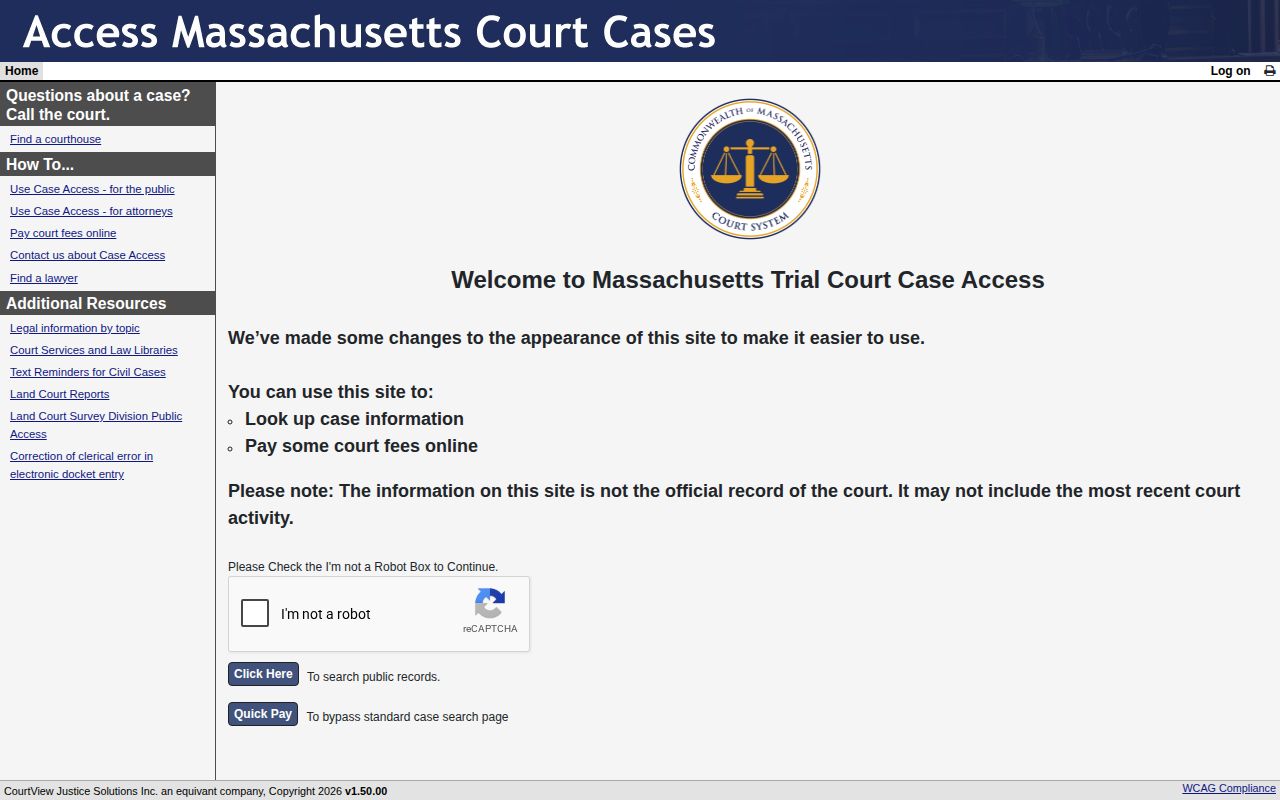
The court interface helps locate the legal case. Pair its result with the Hampshire or WCC custodial record for an actual release time and destination.
Note: Use the arrest town, case number, and docket prefix to identify the correct Hampshire court before contacting a clerk.
Hampshire Release Records and History
The structure of the Hampshire Sheriff’s Office explains part of its records path. Official state material dates the main and work-release building to 1985, modular dorms and storage to 1989 with renovation in 2019, the Regional Holding Facility to 2001, and the maintenance building to 1996. These dates describe the Rocky Hill campus, not the duration of a particular person’s record.
Hampshire county government was abolished, and the Sheriff’s Office became a Commonwealth state agency in 1998. That is why a request to the Hampshire Sheriff is handled as a state-agency public-record request. The official building overview also helps distinguish the main jail, work-release spaces, and regional holding role. It does not create separate public person locators for each unit.
Two Rules for Hampshire Records
Two access regimes sit side by side. Executive records held by the Hampshire Sheriff or MA DOC follow G.L. c. 66, including its written-response and fee rules. Court case records do not. They follow the Trial Court’s public-access rules, and the clerk at the court where the case was filed supplies the official docket and documents.
This matters when a search fails. A statutory public-record request belongs with the sheriff or state correction agency for an existing release, transfer, or discharge record. A request for a docket, order, or judgment belongs with the court clerk. Sending a ten-business-day executive demand to a court does not convert the court file into an executive-branch record. Trial Court Rule 2 instead governs courthouse access to public case records.
Use both channels when the facts require both. The court explains why release was authorized. The custodian establishes when physical custody ended and where the person went.
Hampshire Release Status by System
A released-person search works best as a set of matched questions. Current county custody, a past county release, a state-prison discharge, and the end of federal custody are not stored in one Hampshire database. The checks below keep each system in its proper role.
Hampshire custody
Call the sheriff for present custody and request the release calendar or OMS fields for a past exit. There is no public roster.
Massachusetts state custody
Use VINELink only for MA DOC participation, then request the durable DOC release or discharge record.
Federal BOP custody
The BOP locator covers federal inmate records from 1982 forward and may show a past release date. It does not prove freedom from all other custody.
ICE or USMS custody
ICE ODLS tests present immigration custody. USMS has no comparable historical public release locator, so records and the federal docket may be needed.
Massachusetts VINE can provide MA DOC location and release notifications, but it is not the county notification layer. BOP status such as “Released” or “Not in BOP Custody” confirms only the end of BOP custody. An ICE non-result may reflect transfer, removal, release, a spelling mismatch, or another status. Every result must be read within the system that produced it.
Note: A locator result is operational evidence, while a release certificate, calendar entry, or official order is the stronger durable record.
Hampshire County Release Facilities
Four facilities belong in the Hampshire release path. They do not share one public roster, and one is outside the county. Contact the office that physically held the person, then use the originating court or receiving agency to complete the custody history.
- Hampshire County Jail and House of Correction: the main Rocky Hill jail and county-sentence facility. Exits include community release, supervision, legal-status change, or transfer.
- Hampshire County Sheriff’s Regional Police Lock-Up: a brief arrest-stage unit. Confirm bail, court movement, continued Hampshire custody, or transfer with the sheriff, arresting agency, and court.
- Bridge to the Future: a lower-custody pre-release placement at 272 Grove Street. Residence there does not mean the Hampshire sentence has ended.
- Western Massachusetts Regional Women’s Correctional Center: the Hampden Sheriff facility in Chicopee serving Hampshire women. WCC controls the physical release record, while the Hampshire court controls the local case record.
No current MA DOC prison or federal BOP institution is located in Hampshire County. A Hampshire resident may still be discharged from a state or federal prison elsewhere, but that is a system-level search. The Rocky Hill Re-Entry Collaborative is a post-release residence for parolees and should not be called a jail.