
Hampshire Jail Release Paths
The Hampshire County Jail and House of Correction holds pretrial and medium-security sentenced people. Official material also describes regional arrestees and pretrial detainees. The sheriff can house county, state, and federal inmates by agreement, but the building remains a county jail and house of correction. An agreement does not turn it into a state or federal prison.
A person may leave by bail, recognizance, court order, time served, expiration, parole, probation, or another lawful release. The sheriff also records movements to MA DOC, another county, a warrant-holding agency, federal authority, or immigration authority.
Confirm Hampshire Jail Release
No public roster or release feed resolves a named person. Start with the Hampshire Sheriff’s custody record, then reconcile it with the court and any receiving system.
- Gather the full name, booking date, arresting agency, and case number.
- Call (413) 584-5911 and ask whether jail custody ended.
- Request actual date and time, authority, release type, and destination.
- Use MassCourts and the proper clerk to identify the legal order.
- Send a narrow request to the Records Access Officer when needed.
- Follow any transfer to the receiving agency.
The Hampshire County released-inmate search explains the wider custody chain. A missing result in the wrong system is not proof of release.
Hampshire Same-Day Record Fields
Because no Hampshire County 24-hour list appears online, these are fields to request, not columns on a public feed. G.L. c. 126, § 40 requires the sheriff to record release type and other correctional data. The release calendar and agency system add the facts needed to distinguish an exit from a transfer.
| Field | What it establishes |
|---|---|
| Name and identifier | Connects the event to the correct booking. |
| Release date and time | Shows whether the event falls within the requested day. |
| Release authority | Identifies the legal basis for the event. |
| Release type | Separates bail, recognizance, time served, expiration, supervision, and transfer. |
| Destination | Shows whether the person entered the community or another agency’s custody. |
| Case or booking number | Supports comparison with court and later records. |
The sheriff’s quarterly report is aggregate and non-identifying. It can show patterns, but it cannot name who left during a particular day.
Request Hampshire Release Records
The Hampshire Sheriff contact directory identifies the Public Information/Records Access Officer. Describe an existing record rather than asking the office to conduct research. A focused request can seek the booking or admission date, actual release date and time, release authority and type, destination if transferred, booking identifier, and case number. Ask for electronic delivery and all segregable public portions.
Massachusetts Public Records Law normally requires a response within ten business days. The agency may produce records, identify exemptions, give a fee estimate, or state a lawful production schedule. Black-and-white paper copies are capped at five cents per page, and the first four labor hours for a state-agency request are provided without charge. Hampshire county government was abolished and the Sheriff’s Office became a Commonwealth agency in 1998, which explains why the state-agency framework applies.
For a broader range, use the Hampshire County 72-hour release route. It still relies on custody records but can catch an estimate that was off by one day.
Hampshire Release or Transfer
A release event does not always mean freedom from custody. Massachusetts data separates community releases from movements to another criminal justice agency. That movement may mean MA DOC, another county, an out-of-state sentence, federal authority, immigration authority, or an agency holding a warrant. “Remain incarcerated” can mark the end of one legal status while a second status begins.
| Recorded result | Best next check |
|---|---|
| Bail or recognizance | Sheriff for gate time; court for conditions. |
| Time served or expiration | Sheriff release record and sentence docket. |
| MA DOC transfer | County destination, then the official state-prison route. |
| Federal or immigration transfer | The named receiving system. |
Bail ends jail custody while the case continues. Recognizance permits release based on a promise to return. Time served generally reflects a sentence equal to credit already spent in custody. Each outcome requires its own plain reading.
The county correctional data statute shows the release-related information sheriffs record.
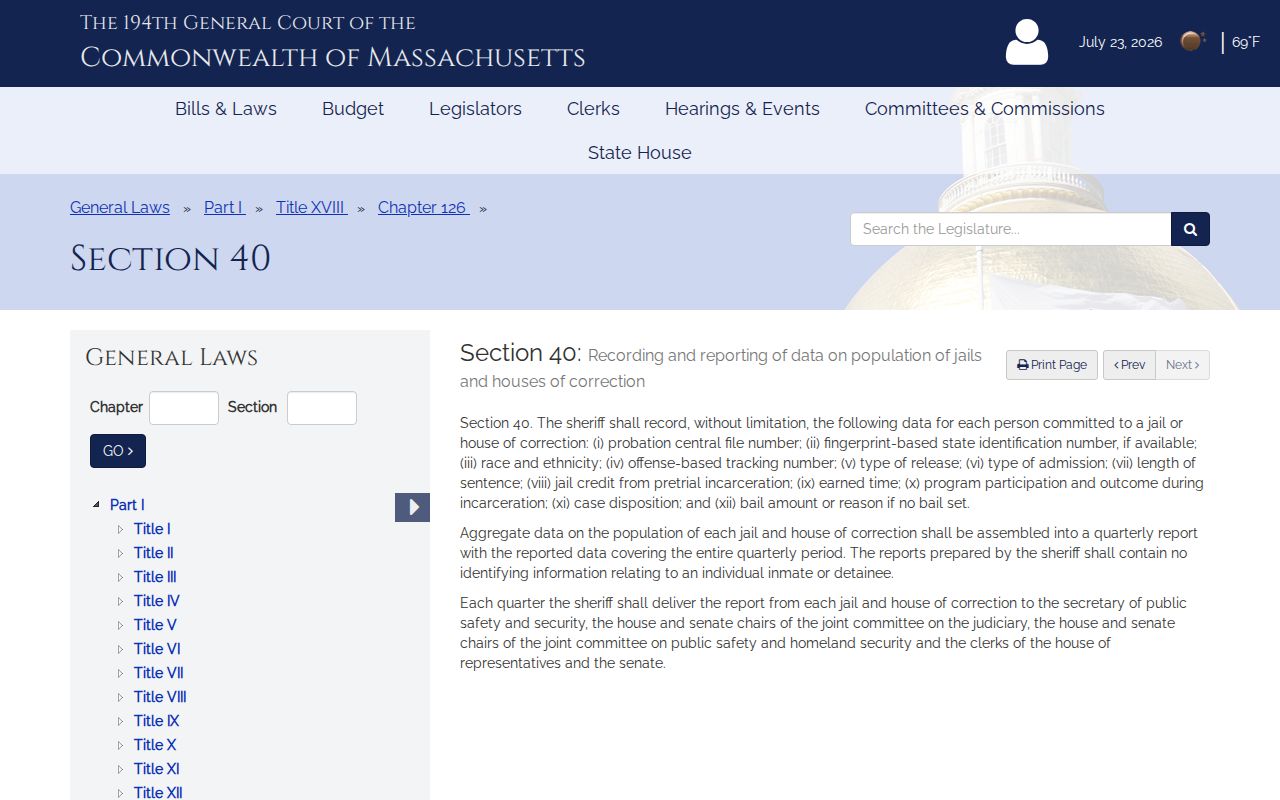
Those fields support a targeted request even though Hampshire County does not display a daily roster.
Hampshire Jail Custody Roles
The words “jail” and “house of correction” describe different custody roles at the same Hampshire facility. The jail side is tied to pretrial detention. The house-of-correction side serves county sentences of no more than two and one-half years. That distinction changes what release evidence should exist. A pretrial exit is often linked to bail, personal recognizance, or a new court order. A sentenced exit may reflect time served, sentence expiration, parole, probation, or another authorized result.
The same Rocky Hill address does not make every person’s legal status the same. Audit material describes regional arrestees, pretrial detainees, and sentenced people. The sheriff also states that county, state, and federal inmates may be housed by agreement. For a state or federal person temporarily held at Hampshire, the local record should identify the handoff, while the state or federal system becomes the next custody source. Calling the building a county jail remains accurate; calling it a state prison or federal institution does not.
A search should therefore begin with the booking or commitment context. Ask whether the person was awaiting court, serving a county term, or held for another authority. Then match the release type to that role. This avoids treating a court trip, status change, or outside-agency transfer as final discharge.
Note: One Hampshire facility can produce several kinds of exit records because it serves both pretrial and county-sentence functions.
After a Hampshire Jail Exit
The next durable record depends on what followed the Hampshire jail event. A person released without supervision may have no continuing corrections-locator entry. The sheriff’s release record and the court docket then remain the main sources. A person released on parole is under the Massachusetts Parole Board. A probationer remains tied to the sentencing court and Massachusetts Probation Service. Those forms of supervision are not interchangeable.
A Hampshire transfer to MA DOC changes the correct search system. Massachusetts VINE is useful only after state custody is involved because official state guidance says that only MA DOC participates in the Massachusetts VINE program. It is not a dependable archive for someone held only at the Hampshire County Jail and House of Correction. If the destination is another county, a warrant-holding agency, federal authority, or immigration authority, contact that named custodian instead.
The destination field closes the gap between systems. Without it, a Hampshire release date confirms only that this facility’s custody segment ended. With it, a requester can test whether the person returned to the community, began supervision, or remained confined elsewhere. For older events, retain the booking number and case number so the sheriff, court, and receiving record can be matched without relying only on a common name.
When Bail Does Not Mean Release
At the Western Massachusetts Regional Women’s Correctional Center, paying bail on one mittimus does not ensure a physical exit. A mittimus is the court document authorizing custody. WCC checks for other active warrants, detainers, holds, or mittimuses. One case may be cleared while another keeps the person confined.
Electronic monitoring can add a second delay. When a court orders monitoring, WCC states that the person remains held until Probation completes setup and transport. Payment, authorization, and gate departure may fall at different times. Ask WCC for the actual release time and each hold’s resolution.
Note: A bail receipt proves payment on that matter, not the end of every custody authority.
Hampshire Jail Records Contact
The Hampshire Sheriff is the custodian of the local release-calendar and management record.
Hampshire County Jail and House of Correction205 Rocky Hill Road
Northampton, MA 01060
Mail: P.O. Box 7000, Northampton, MA 01061-7000
Phone: (413) 584-5911
Ask for the booking date, actual release time, authority, release type, destination, identifier, and case number. Request electronic delivery and segregable public portions.
Hampshire Jail Campus History
Official state material dates the main and work-release building to 1985. Modular dormitory and storage buildings date to 1989 and were renovated in 2019. The Regional Holding Facility dates to 2001, and the maintenance building dates to 1996. These dates explain why several custody and program roles share the Rocky Hill campus.
Hampshire county government was abolished and HSO became a Commonwealth agency in 1998. That history explains why its records requests use the state-agency framework.
Why Hampshire Requests Beat Mirrors
Hampshire’s lack of a public feed creates a clear records path. The agency’s own system and release calendar contain date, time, and authority fields. A commercial mirror may confuse booking with release. A booking today proves intake, not an exit.
Write the range with start and end times, name the person and known booking reference, and request release type plus destination. If court and sheriff records appear to conflict, ask the clerk about the legal order and the custodian about the physical handoff.