
Hampshire County Parole vs Probation
Parole and probation can both follow a Hampshire County custody case, but they come from different legal acts. The Massachusetts Parole Board decides whether an eligible person may serve the rest of a sentence outside an institution. Its Field Services Division supervises that parole. Probation is imposed by a Trial Court judge, either instead of a jail term or after a custodial portion of a sentence. The sentencing court and Massachusetts Probation Service supervise it.
A person released from the Hampshire County Jail and House of Correction may leave with probation, parole, neither, or a transfer to another custodian. Physical departure alone does not identify the status. The sheriff release record establishes when Hampshire custody ended and where the person went. A Parole Board permit or decision supports parole status. A court docket and sentence support probation status. Those records should agree before a firm conclusion is drawn.
| Point | Parole | Probation |
|---|---|---|
| Who orders it | Massachusetts Parole Board | Sentencing court |
| What it follows | Release from a prison or house-of-correction sentence | A court sentence, with or without prior custody |
| Public route | Public life decisions, final vote records, or authorized Board records | MassCourts docket and the sentencing court |
| Live public lookup | No general statewide parolee name search | No public live probation status search |
| End record | Certificate or record of termination | Court termination or case event |
- Parole
- Community service of the balance of a sentence under Parole Board control.
- Probation
- Court-ordered community supervision managed through the Probation Service.
- Discharge
- The formal end of a sentence or supervision term, not merely release from a building.
- Absconder
- A supervised person alleged to have left oversight or stopped required contact.
Verify Hampshire County Post-Release Supervision
There is no single Hampshire County parole and probation search. Verification begins with the custody and sentence source. A county release record answers whether the person left the jail for the community or another agency. The court docket explains whether probation was part of the sentence. Parole material answers whether the Board granted release and whether conditions delayed or redirected the actual move.
- Confirm the person and case. Use the full legal name, court, docket number, and any commitment identifier already lawfully known.
- Ask the Hampshire Sheriff whether county custody ended, the actual release date, release type, and destination. A transfer is not community discharge.
- Search MassCourts for the sentence and later events. A probation order may appear, but the docket is not live proof of compliance.
- For parole, check public life-sentence decisions when relevant or make a focused Parole Board record request. Ask for the public vote, permit or release date, and termination certificate rather than confidential field notes.
- Call the likely field or court probation office to confirm routing. Ask what authorization is required before expecting a personal status answer.
- Reconcile the records. The decision, physical release record, supervision source, and any receiving-agency record should describe the same transition.
A positive parole vote does not prove that a person walked out that day. The vote may depend on an approved plan, a program opening, a cleared warrant, or acceptance by another jurisdiction. A person may be paroled directly to federal, immigration, out-of-state, or other Massachusetts custody. The Hampshire County released-inmate search and record path explains how to confirm the physical handoff.
Note: Ask for public final records, not confidential addresses, treatment notes, risk reviews, or daily supervision details.
Hampshire County Parole Office Routing
Parole Region 5 in Springfield is the practical western field contact for a Hampshire County parole question. The Board does not publish a county-to-region assignment table, however. Callers should ask the office to verify the assigned region instead of assuming that each Hampshire case is supervised there. The central Board office can route a request when the field assignment is unclear.
Parole Region 5
436 Dwight Street
Springfield, MA 01103
(413) 784-1210
Monday through Friday, 9 a.m. to 5 p.m.
Massachusetts Parole Board
12 Mercer Road
Natick, MA 01760
(508) 650-4500 or (866) 480-6272
Probation takes a different route. A Hampshire County probation matter starts at the court that imposed the sentence, such as Northampton District Court, Eastern Hampshire District Court, or Hampshire Superior Court. The Office of the Commissioner of Probation has a general line at (617) 727-5300, weekdays from 8:30 a.m. to 4:30 p.m., but a local court probation department holds the case-level path.
Massachusetts guidance is strict about disclosure. An adult probation officer cannot discuss a probationer's status with a spouse, relative, friend, neighbor, or concerned member of the public without the probationer's signed release. The public docket may show that probation was ordered, violated, modified, or ended, yet it does not show private case management or prove current compliance.
Hampshire County Parole Warrants
A parole warrant can change the meaning of a Hampshire County release. Under 120 CMR 303, a parole-violation warrant may issue when probable cause supports a violation, including reasonable grounds that the parolee absconded. Issuance stops service of the underlying sentence. Service of the warrant and detention start that service again. Thus, a person may be outside a jail but not discharged and not in good standing on parole.
The Board's Warrant and Apprehension Unit accepts information about a wanted parolee at (617) 376-6269. State Police dispatch is (508) 820-2121. This is a tip channel, not a public absconder database and not a route to confidential records. Massachusetts publishes no general name-searchable parole absconder list. Probation warrants belong to the court and probation system. DOC's most-wanted page concerns escapees. These three statuses should never be merged.
Note: Report urgent safety issues through the proper public-safety channel, not through a records request or a supervision search.
Hampshire County Supervision Discharge
Release from Hampshire County custody and discharge from supervision are not the same event. Parole ends through Board action or completion of the governing sentence. A useful record is the certificate of termination or another final Board record stating that jurisdiction ended. Probation ends through the sentencing court's process and should be checked against the docket or an authorized probation record. A quiet period with no new docket entry is not a substitute for a formal end record.
Ordinary parole records remain controlled by CORI rules. A person may request their own file. A third-party request usually requires a focused written request and a completed Third Party Authorization-CORI Release form. Public life-sentence decisions are a narrow exception. For a purpose-neutral check, ask for a public final vote date, parole permit or release date, and certificate of termination. That scope is more likely to produce a clear answer than a demand for an entire field file.
The actual custody trail still matters. If the parole decision sent a person to another institution or authority, later discharge must be confirmed there. A Hampshire Sheriff record may show transfer while the receiving record shows continued custody. Final verification pairs the sentence or supervision end record with the actual release record.
Hampshire County Reentry Supervision Stages
Hampshire County has three local programs that sit at different points in the custody-to-community path. Bridge to the Future is a small pre-release custody placement for men nearing the end of a Hampshire sentence. Residence there does not prove the sentence ended. A participant can move toward discharge or community supervision, but may also return to a more secure placement.
The Rocky Hill Re-Entry Collaborative is different. It is a post-release Hampshire Sheriff and Parole collaboration for parolees living in a treatment-focused setting. Staff are present around the clock, and a new resident begins with an on-site acclimation period. The Community Justice Support Center on Pleasant Street serves people under community supervision. Its services do not turn it into a jail or inmate locator.
These stages help decode a record. “Bridge to the Future” points to continued lower-custody placement. “Rocky Hill” can describe supervised community residence after release. A Community Justice Support Center connection concerns services in the community. The governing sheriff, court, or Parole Board record remains the source for the legal status.
The official Massachusetts Parole Board page shows the agency context behind parole release and supervision.
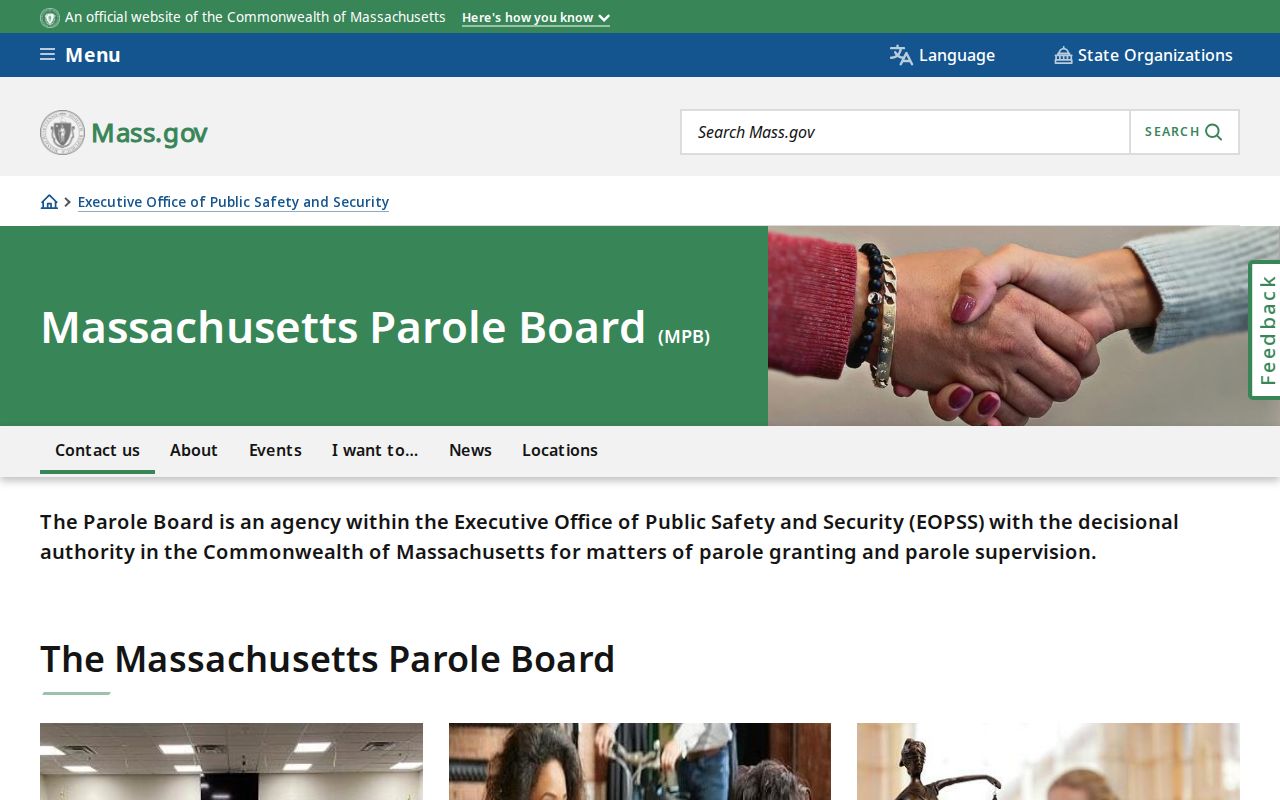
The screenshot identifies the state agency, while a Hampshire County case still requires the specific decision, release record, and field-office route.
Hampshire County Parole Hearing Records
Public hearing access is limited but useful. The Board's ordinary institutional release, rescission, and revocation hearings at DOC and house-of-correction sites are generally closed. Life-sentence hearings and most Central Office proceedings are open, subject to the Board's exceptions. The Life Sentence Hearing Calendar publishes month-by-month documents, so the collection page is more reliable than a link to one month's file.
The current records of decision and past archive form the public results route. They are grouped by hearing year and name rather than presented as a universal parolee search. Supported outcomes include a positive vote, denial, waiver, postponement, and other pending action. A rescission can withdraw, postpone, or retain a prior vote. Revocation may be temporary or permanent.
Eligibility depends on sentence type and law. A normal state sentence uses the minimum term, less eligible deductions, under G.L. c. 127, § 133 and Board rules. A house-of-correction aggregate term has its own eligibility framework. Mandatory minimums and specified life or habitual-offender rules can alter or bar parole. No statewide percentage safely resolves every Hampshire County sentence.
Note: A public hearing outcome supports the Board decision, while the sheriff or DOC record confirms the actual exit and destination.