
Hampshire County Projected vs Actual Release
A projected release date is an estimate based on the sentence structure and the credits already earned or expected. The Massachusetts Department of Correction uses that plain-language term in its Family and Friends Handbook. Technical records may instead show Release Date, Earliest Release Date, Earliest Release Max Date, minimum sentence date, maximum date, or actual release from sentence date. Those terms are not interchangeable.
The actual release date records what happened. A projected date may move before then. Sentence staff must reconcile court commitment papers, jail credit, earned credit, forfeitures, warrants, concurrent or consecutive terms, and later orders. The final event may be discharge to the community, parole, home confinement, or transfer to another authority. A county record that says “transfer to DOC” marks the end of Hampshire custody but not the end of confinement.
A pretrial detainee has no sentence-expiration date. Bail, recognizance, dismissal, a new court order, or a hold may lead to release or continued custody. The court docket supplies legal authority, while the jail record supplies the physical release or transfer. Calling that changing status a projected sentence date would be misleading.
- Projected Release Date
- An estimate using credits already earned or expected to be earned.
- ERD
- The earliest eligibility date considering parole eligibility and deductions that may be earned.
- ERD Max
- The earliest maximum-side date based on the controlling term and credits, excluding parole eligibility.
- Actual release
- The recorded custody event, which may be community release or a handoff to another agency.
Find Hampshire County Projected Release Dates
The correct route turns on who holds the commitment. A person serving only a Hampshire House of Correction sentence may never appear as an MA DOC prisoner. The Hampshire Sheriff maintains that county commitment and release calendar. A person sentenced to state prison may leave the county by transfer, after which MA DOC becomes the proper date source. The county transfer date and the later state release date describe different events.
- Identify the court, case, sentence type, and present custodian. Do not start with a state search when the person remains in county custody.
- For a Hampshire county sentence, obtain the mittimus or sentencing docket, then ask the sheriff for the calculated release information and actual release calendar record.
- For a state sentence, use the official MA DOC locator route, which directs users to VINELink.
- Record every displayed date with its exact label. Do not relabel ERD, ERD Max, or another calculated term as the actual release date.
- Ask MA DOC for the discharge or release record when a live result is missing, old, or not detailed enough.
- Check parole, warrants, detainers, and any receiving agency before treating the date as community release.
The Hampshire County release record search provides the broader custody-system path. A court docket can confirm the imposed term and jail credit but may not show the precise time a person left. The sheriff or DOC release record fills that physical-custody gap.
Note: Save the date label, source, and search date so a later update can be compared without changing its meaning.
Hampshire County Earned-Time Release Rules
Massachusetts has no general 85 percent rule. Truth in Sentencing applied to offenses after June 30, 1994 and ended the former automatic statutory good-time system. It did not require every person to serve the same fixed share. Current earned deductions remain available under G.L. c. 127, § 129D, subject to eligibility, sentence type, program participation, and statutory limits. Mandatory minimum and habitual-offender provisions can block ordinary deductions or parole for specified periods.
State and county monthly limits differ. For a qualifying state prisoner, § 129D permits up to 7.5 days for a qualifying program or activity in a month, with no more than 15 days total through that participation provision. For a house-of-correction sentence, the statute permits up to five days per qualifying activity per month and no more than ten days total per month. Credits must be earned and awarded. They are not guaranteed merely because the statute allows them.
Special state-prison completion credit can reach up to 80 days for a designated completion, with aggregate completion credits capped at 17.5 percent of the imposed maximum. Statutory provisions also limit combined reductions of an imposed minimum or maximum to 35 percent. The related release-to-supervision rule uses a 35-percent floor. Those limits are ceilings on possible credits, not a promise that a person will receive the maximum reduction.
The official earned-deduction statute shows why a projected Hampshire County release date must come from the proper sentence calculation.
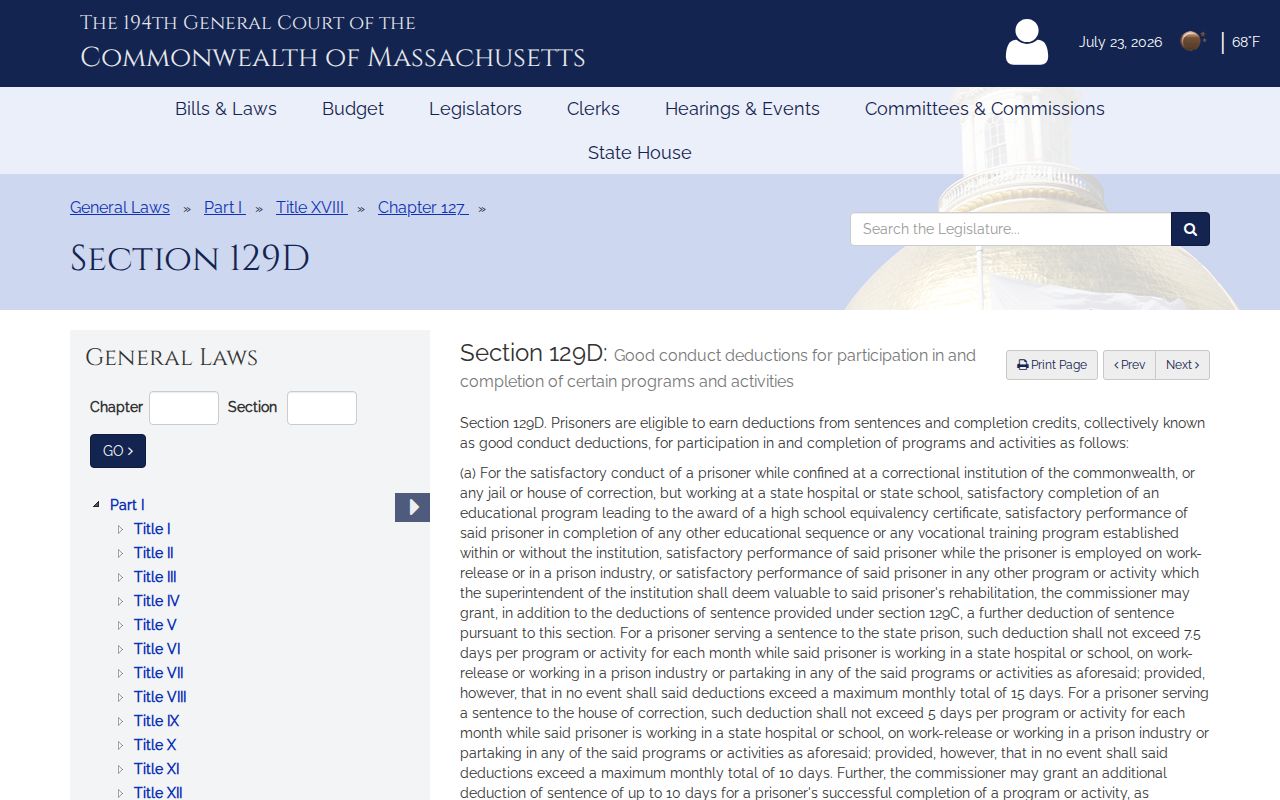
The statutory text supplies the available credit framework, while the sheriff or DOC date unit applies actual awards and sentence restrictions to one person.
Why Hampshire County Release Dates Change
Sentence length alone cannot predict the final Hampshire County release date. Credit can be earned, withheld, lost, or restored. A new warrant can change the destination. Consecutive sentences can make the end of one term the start of another. A court can revise the legal basis through a stay, vacation, amended commitment, or other order. The date must be recalculated as those inputs change.
| Factor | Effect on the date or destination |
|---|---|
| Pretrial jail credit | Credited days reduce the time remaining when lawfully applied to the sentence. |
| Earned program credit | An eligible, awarded deduction may move an applicable projected date earlier. |
| Credit loss or restoration | Discipline or later restoration can move the estimate in either direction. |
| Concurrent or consecutive terms | Overlapping terms compute differently from “from and after” terms. |
| Warrant or detainer | The person may transfer to another authority instead of entering the community. |
| Court order | A stay, correction, vacation, or new commitment can alter the legal calculation. |
| Parole action | Eligibility and a positive vote do not guarantee immediate physical release. |
MA DOC sentence rules call for formal review and communication of the calculation. Under 103 CMR 410, staff prepare for an upcoming discharge, update credits, and approve release materials. General discharge preparation begins well before the earliest projected date, with a longer advance period for identified sex offenders. That work shows why a live estimate can change before an actual exit.
Note: An administrative release from one legal status can be followed at once by another term, leaving the person incarcerated.
Confirm Hampshire County Release Dates
For county custody, ask the Hampshire Sheriff for the actual release date and time, release authority or type, and destination. The internal release calendar is more decisive than a sentence estimate. Pair it with the court docket when the legal order matters. If the record says the person went to another criminal justice agency, follow that receiving agency before concluding that confinement ended.
The Hampshire Sheriff contact directory identifies the public-information and records route. A focused question should state the person, approximate custody dates, and court case when known, then ask for the releasable date, time, type, and destination fields. For the court side, search MassCourts and use the clerk for the Hampshire court that issued the sentence. The docket explains the order, while the custodian confirms the physical event.
For state custody, capture the live VINELink result, then request the MA DOC discharge or release record when permanent proof is needed. The Hampshire County VINELink release check explains the alert steps and the MA DOC-only coverage rule. A release alert is useful, but it remains a prompt to verify with DOC. If parole follows, check the Parole Board decision or permit and the authorized supervision route.
Federal and immigration custody do not use Massachusetts VINE. A BOP result may show a past release date and “Released” or “Not in BOP Custody,” which establishes only that BOP custody ended. ICE's public locator tests current detention and can fail to show a person for several reasons. A date check is complete only when the responsible system, actual event, and destination line up.
Hampshire County Sentence Release Calculation
A Hampshire House of Correction term differs from a state-prison sentence. The county term is one imposed term and may not exceed two and one-half years for an offense. A sentenced person serving an aggregate county term of at least 60 days is generally parole-eligible at one-half of the aggregate term or two years, whichever is shorter, unless mandatory-minimum terms alter that result. The Hampshire Sheriff, not the MA DOC date unit, holds the county commitment and release calendar.
A sound county estimate begins with the mittimus, which is the court's commitment order. Apply legally awarded pretrial jail credit. Add only eligible credits that have actually been awarded. Reconcile concurrent and consecutive terms, mandatory minimums, warrants, and detainers. Then test the statutory weekend or holiday rule. A federal good-conduct formula does not apply to a Hampshire house-of-correction term.
The Hampshire Sheriff's Office operates the main county jail and house of correction. That makes its sentence and release records the local source even though Massachusetts also supplies statewide correctional law and reporting standards. A state portal should not be used to invent a county date that the sheriff has not confirmed.
Parole eligibility is not the same as a parole grant, and a grant is not the same as a door date. A Board vote may depend on a suitable plan, cleared defaults, program acceptance, or another jurisdiction. A transfer to federal, immigration, out-of-state, or other Massachusetts custody also ends one agency's custody while continuing confinement elsewhere.
Hampshire County Weekend Release Shift
G.L. c. 127, § 150 creates a specific calendar adjustment. When a prisoner's term expires on Saturday, Sunday, or a legal holiday, discharge occurs on the preceding day. A Friday actual discharge can therefore be correct even when the unadjusted expiration falls on the weekend.
This rule applies to sentence expiration. It should not be stretched to bail, a Parole Board vote, electronic-monitoring setup, detainer clearance, or each type of release. Those events follow their own authority and operational steps. The distinction is vital when comparing a docket, a projected date, and the final sheriff or DOC record.
Angle O in the Hampshire research joins three date quirks that are easy to confuse: there is no universal 85 percent service rule, state and house-of-correction monthly credits differ, and a weekend expiration shifts to the prior day. Each can affect the date analysis, but only the final release record proves what occurred.
Note: The prior-day statute changes a sentence expiration date, not every court-ordered or agency-controlled release process.